
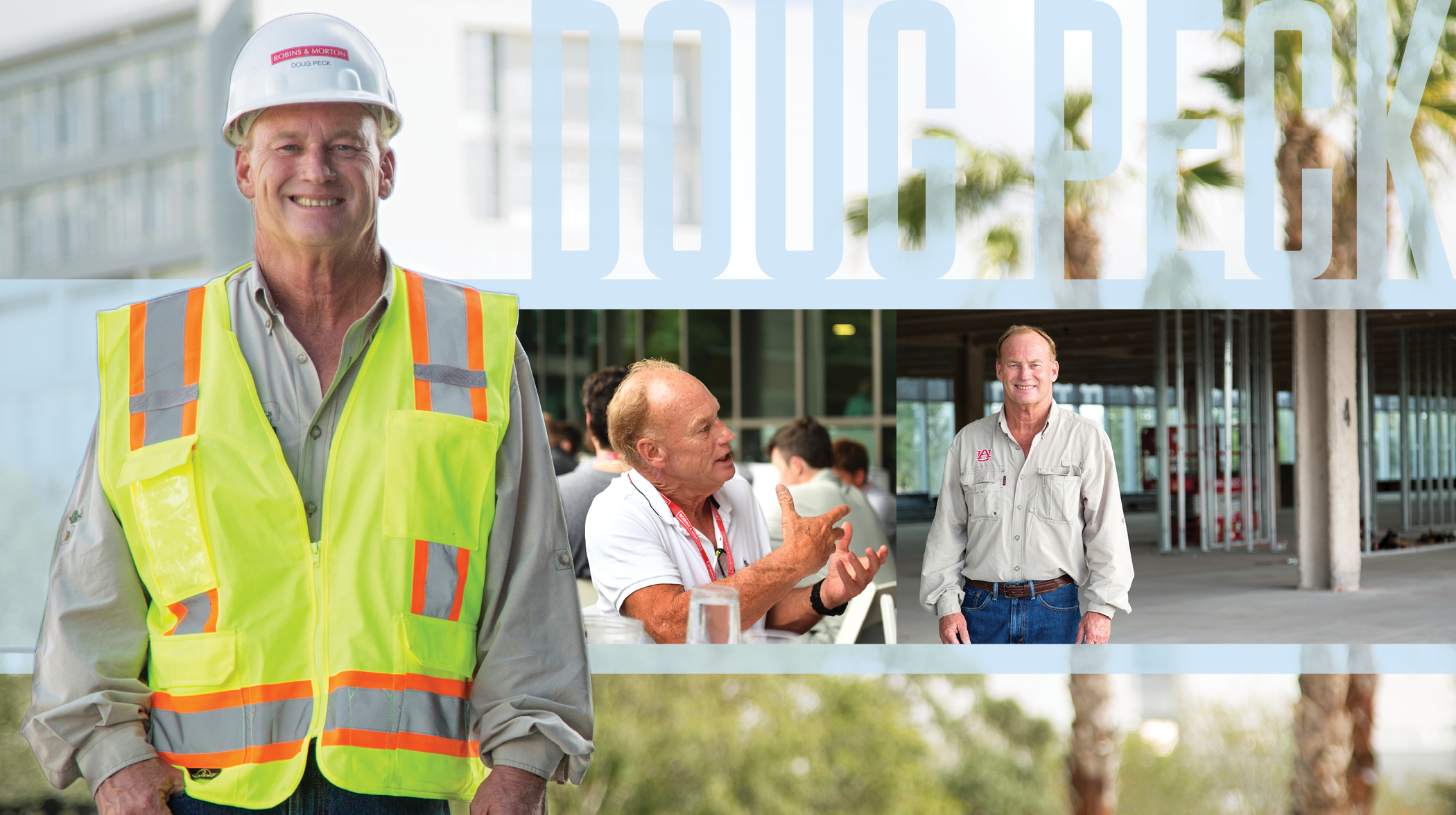
In 1986, Doug Peck walked into Robins & Morton’s Birmingham office and asked if there were any jobs available. That question turned into four hours of interviews — the last with then-company President Barry Morton—which became a four-decade career.
Since 1986, Doug has led more than 60 projects — several of which have been Robins & Morton’s most high profile. Along the way, he’s seen the company grow, the industry evolve, and Robins & Morton team members succeed. Here’s a look at his story.
What was your background before joining Robins & Morton?
I’ve been working in construction since I was about 15 years old. The contractor I was working for in Florence, Alabama, suggested that I go to Auburn University. I said, “Why Auburn?” He said, “They have a construction science program down there.” I said, “There’s no way in the world I’m going to get in.” He said, “If I help you get in, will you go?” And I said, “Sure.”
How did you become a part of the Robins & Morton team?
I made great relationships with professors at Auburn, and I was telling one of them about [looking for a job after graduation]. He told me about Robins & Morton and suggested I stop by on my way home to see if I could get an interview.
The only name I knew was Barry Morton. I walked in and said, “May I speak to Barry?” And [the administrative assistant] said, “What’s it about?” I told her I was looking for a job.
I thought we would just be setting up an interview, but next thing I knew, I was in interviews for four hours with eight different people, ending in an interview with Barry Morton.
On the day after graduation, at about 5:30 or 6 o’clock in the morning, [Senior Vice President] Robert Gambrell called me. He said, “Hey, do you want to come to an interview with me?” And I said, “When?” And he said, “Can you be here at eight?”
You joined the Robins & Morton team after that interview in 1986. What was your first project?
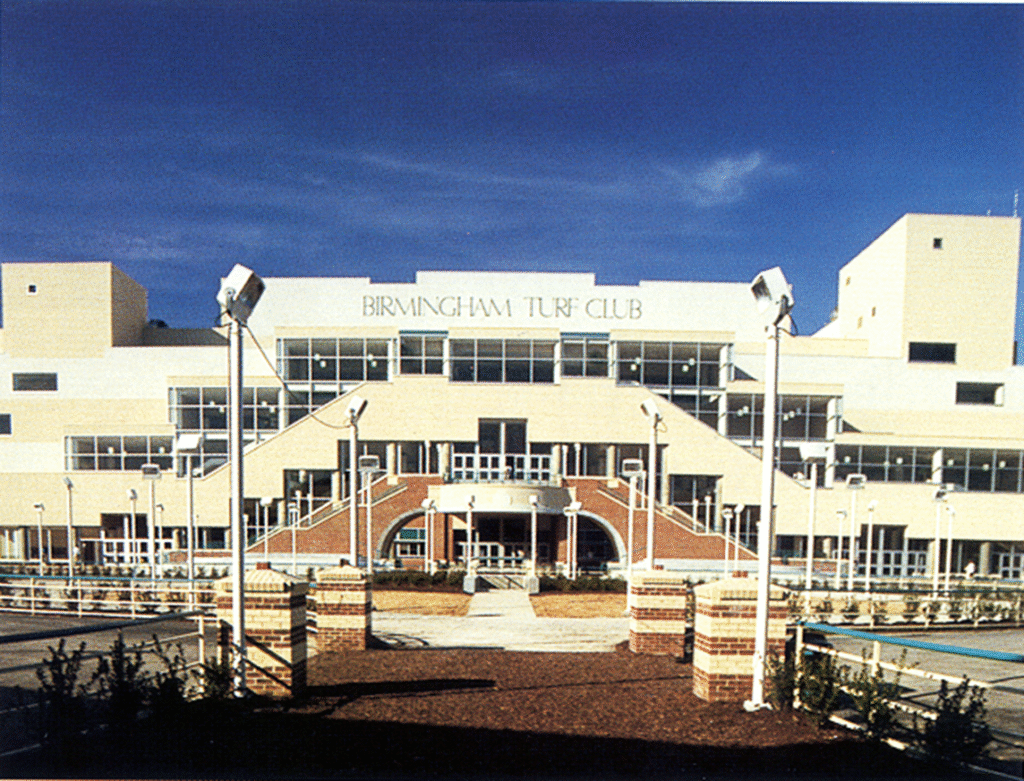
When I started, we had just gotten the Birmingham Turf Club Race Course. It was the biggest job we had done at the time. I’ve been here ever since.
Over your career, how many jobs have you been involved with? Are there any projects that stick out to you?
When I first started, we had a bunch of little jobs everywhere. So, I did 10 or so of those, and then jobs got bigger and longer.
I learned a lot from all the jobs because each one was unique. The first 10 years of my career, I traveled, worked, and learned a lot.
I enjoyed working with the team in Orlando doing the Health Central hospital and medical office building project in Ocoee, Florida. Then there was Eastern New Mexico Medical Center in Roswell. That was one of the first really big ones I was able to do myself.
After that, I did what ‘s now AdventHealth Palm Coast, which was the first one I did in Florida by myself.
I also learned a lot on our Centennial Medical Center project in Frisco, Texas, and our Winnie Palmer Hospital for Women and Babies project in Orlando. I worked in Orlando from around the early 2000s to 2011 or 2012.
In 2012, we got involved with Mayo Clinic, which was a big opportunity for us. It was an adventure. I’d never seen a client so quality-driven. It was fun and very challenging.
After doing the Mayo Clinic project, I went down to Miami Cancer Institute at Baptist Health South Florida. That turned into a really good project, but it was physically exhausting. We had a crazy deadline and ran into a lot of challenges, but we had an incredible team that was as resilient as you can imagine.
In my role, there are always challenges, but I like them, and the people are always great to work with. Our people and clients make the company.
How has the industry evolved throughout your four-decade career?
In the ‘80s and early ‘90s, we were working hard, learning, and building the best we could. We established systems to bring greater consistency and make things even easier for everyone.
In the early 2000s, everything exploded, and we had so much work. When that happened, we hired a lot of new team members, and it was fun, fun, fun. We did a tremendous amount of training, and I was heavily involved with that for about 10 or 12 years.
Now, it’s shifted to the next generation to teach, which is good, because how we used to build is dated now. The buildings are a lot smarter. The next generations teach me how to do some things, and they’re trying to learn some of the old school ways. It’s a balance, and we can’t do it without each other.
For the first decade, I was the student, and for the last three decades, I’ve been one of the teachers. It’s been fun to watch how each generation steps up to do their job. It’s impressive, too.
Over the past two decades, our systems and technology have advanced tremendously, and our buildings are a lot smarter now. As a company, we’ve also made huge strides in safety, team inclusion, and training. When we’ve identified holes in our processes, we’ve filled them — and we’ll continue to do that, because there’s no such thing as perfect.
What makes Robins & Morton special in our industry?
We do what we say we’re going to do. That has been my driver through generations: you said you’d do it, do it. It’s integrity in action.
What do you think is important for our company as we continue to grow and adapt in the future?
I want to make sure that our people are trained in the Robins & Morton Way. It gives us unity as a company. We’re not going to do everything 100% the same, but if we approach our work similarly, that strengthens our culture.
Also, relationships — client and trade partner — and respect of all people are so important. Those things are still valid today.
There’s a lot that I’m excited to see in the years to come.
What’s the biggest thing you’ve learned in your career that you’d like to share?
You really never know what you can’t do, so just keep going, keep trying, and keep doing everything to the best of your ability. You would be surprised at how many people will support you. Also, never underestimate anyone.
Most importantly, enjoy the ride, because it’s a lot of fun.
Ten years ago, Doug participated in an interview with Construction Superintendent magazine. See how his perspective has evolved.