
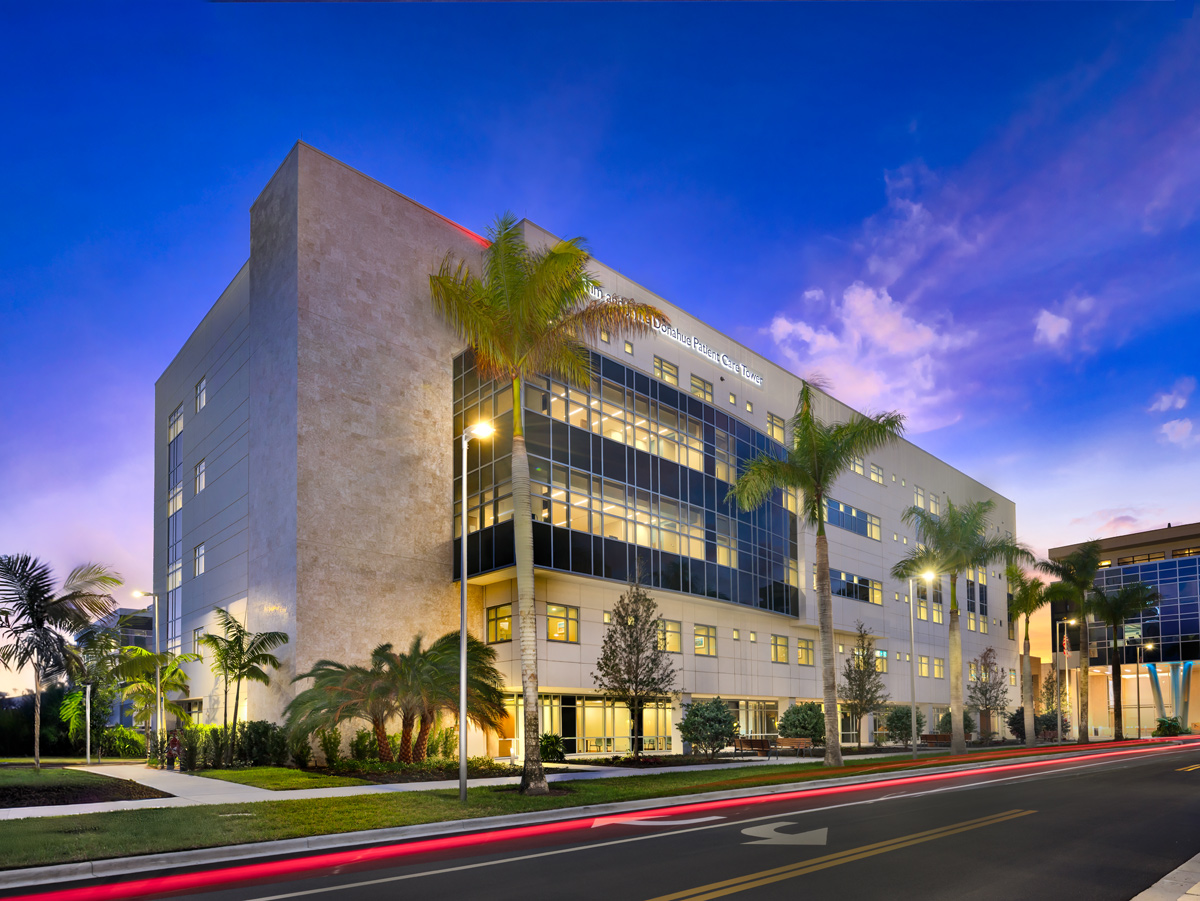
 When Robins & Morton’s Jupiter Medical Center team began work on the $135 million Tim and Jayne Donahue Patient Care Tower, they approached prefabrication not as a supporting tactic but as a strategic driver. That decision was key to delivering the five-story, 139,071-square-foot patient tower and 284,375-square-foot parking deck four months ahead of schedule — even while accommodating added scope.
Here’s how the team’s prefabrication strategy played out.
Exterior and Early Dry-in
The most impactful gains came early, at the building enclosure. Prefabricated exterior wall panels replaced traditional field-built systems and delivered an estimated 12 weeks of schedule savings. In addition, unitized curtain wall eliminated field glazing and finishing, saving another estimated eight weeks versus a traditional approach. With some of this work overlapping, the net effect was approximately 16 weeks of schedule compression on the enclosure.
With the building enclosed sooner, perimeter scaffolding was reduced, congestion eased, and civil work and landscaping were expedited. Interior trades gained access to conditioned space months ahead of plan, making the exterior prefabrication strategy a key contributor to the project’s early completion.
Interior and MEP Prefab
Once the enclosure was secured, prefabrication continued to pay dividends inside the building. Prefabricated electrical home run racks were installed in approximately four days per floor, compared to an estimated three to four weeks per floor if installed traditionally in the field. That dramatic time savings enabled earlier HVAC commissioning and allowed interior finishes to advance without interruption.
Plumbing followed suit. Prefabricated in-wall rough-ins and sink assemblies arrived fully assembled on rolling racks, with fixtures pre-mounted and connections complete. This reduced onsite labor, minimized packaging waste, and significantly cut staging and cleanup time, which are critical advantages on a tight site. Prefabricated patient room headwalls added further consistency and efficiency.
Quality Benefits
Factory-controlled conditions consistently outperformed field-built work. Exterior wall panels arrived smoother, flatter, cleaner, and more uniform than field-applied systems, resulting in fewer touch-ups and a visibly higher-quality façade. Unitized curtain wall delivered similarly strong results: water testing showed only two units requiring retesting out of approximately 20 tested.
These were clear indicators of elevated quality, and these quality gains translated directly into reduced rework and lower risk.
Less Risk on Site, More Value Delivered
Across the project, prefabrication reduced scaffold needs, minimized weather exposure, and helped offset market labor challenges. Fewer workers performing repetitive tasks onsite improved safety and predictability, while reduced material handling and waste supported cleaner, more efficient operations.
Additionally, the schedule flexibility created by prefabrication allowed the team to absorb added scope — including a pharmacy and simulation lab — without impacting the completion date.
The Takeaway
Prefabrication on the Jupiter Medical Center Tim and Jayne Donahue Patient Care Tower proved to be a decisive delivery advantage. It accelerated the schedule, improved quality, reduced onsite risk, and created the flexibility needed to finish early, even as the project evolved.