
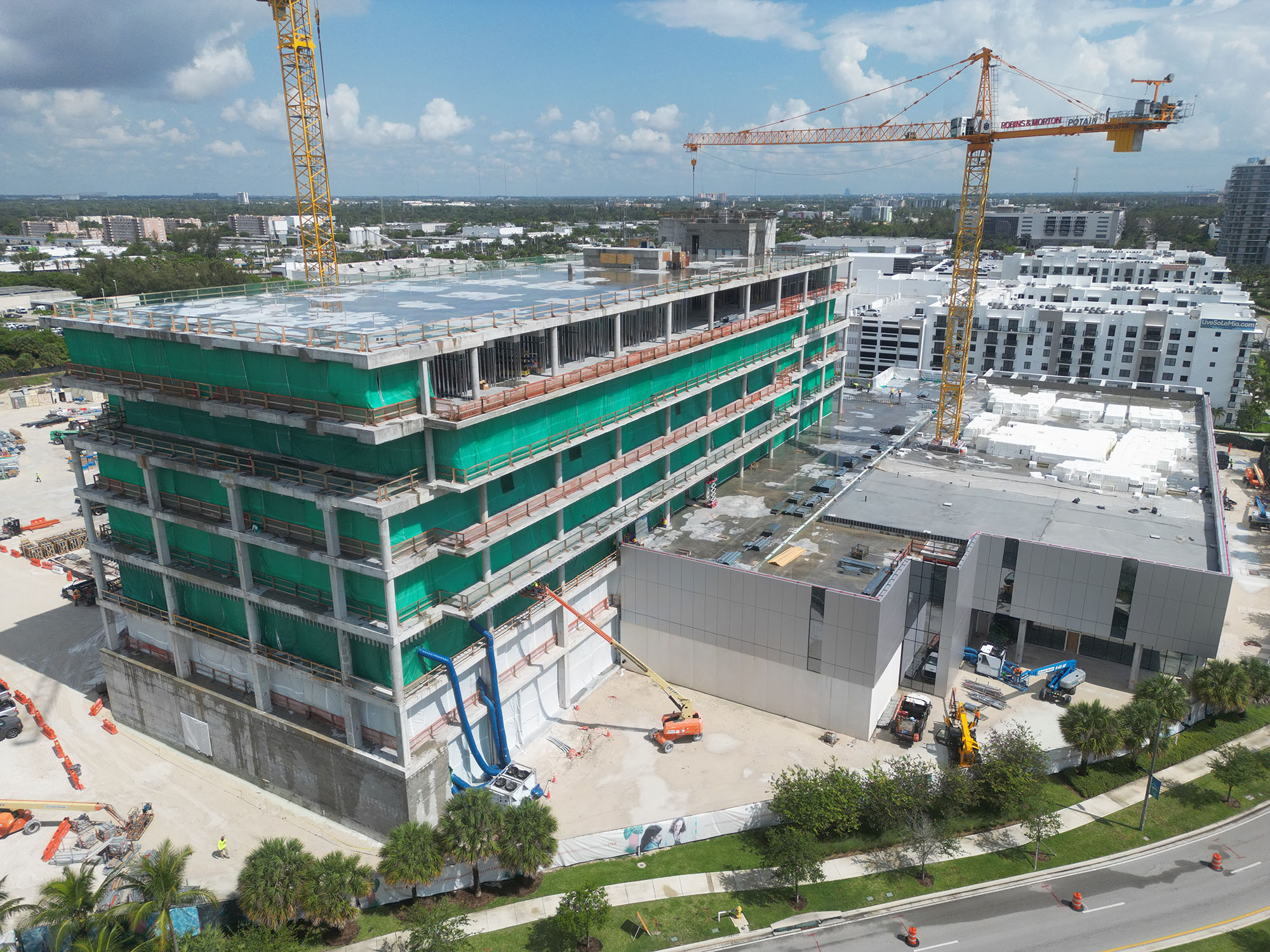
When Robins & Morton mobilized on the mixed-use development of SoLé Mia in North Miami, the team recognized they’d be navigating several significant challenges to build the seven-story, 363,000-square-foot medical center for client UHealth.
Envisioned as a destination for academic healthcare specialties, UHealth SoLé Mia Medical center will offer advanced cancer, vision, urological, cardiology, endocrinology, otolaryngology, gastroenterology, dermatology, and physical rehabilitation care services, among others. The facility will feature ocean and lagoon views and is adjacent to apartment buildings and retail space.
With a unique design — including two glass and concrete spaces cantilevered away from the building by more than 10 feet — and an associated parking deck, UHealth SoLé Mia Medical Center would require a tremendous amount of concrete with a package that totals $40 million. Additionally, the concrete scope significantly influenced the critical path, and any delay would devastate the project schedule. To improve labor availability, quality and cost management, and safety, our team decided to self-perform the concrete scope.
Cubic Yards to Square Feet
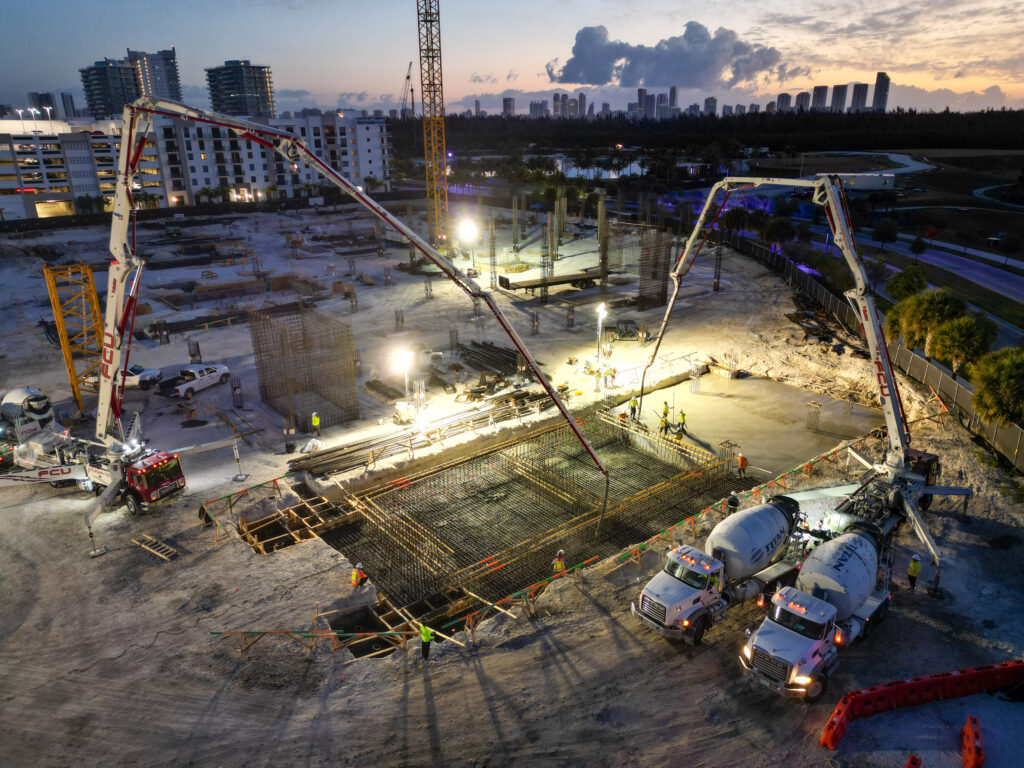
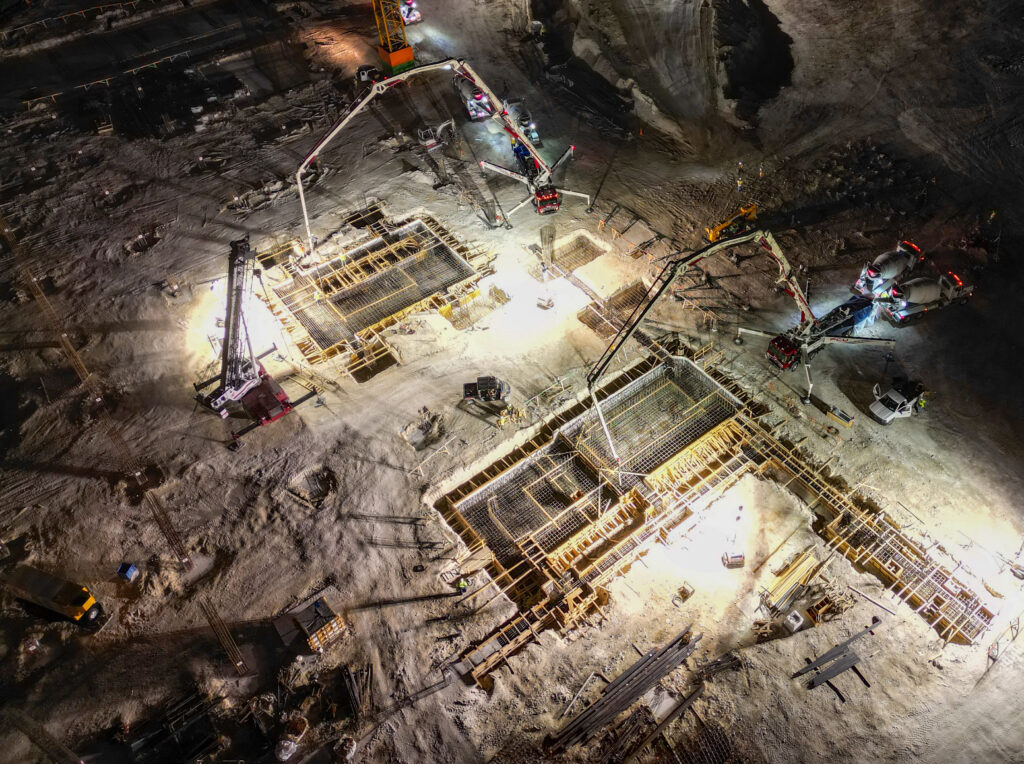
Four months after the project broke ground, the concrete pours began. Over 16 months, the UHealth SoLé Mia Medical Center team performed 382 pours, totaling 40,000 cubic yards of concrete and translating to approximately 550,000 square feet of floor space and roof deck. Several of these pours were the largest and most significant in company history, including multiple 1,300-cubic-yard pours, averaging 200 yards per hour. The largest, however, was a pile cap pour at 1,400 cubic yards.
“This project started not too long after [UHealth Doral Medical Center] topped out, so we have been able to show that we’re more than capable of doing multiple large projects,” Concrete Senior Project Manager Daniel Alonso said. “We got onboard really early — before electricians or other key trade partners — so we were doing the coordination ourselves.”
The Concrete team’s detail-driven approach was especially helpful when building the linear accelerator vaults, which required radiation-shielding mass concrete. Because the type of concrete needed for the shielding was ambient temperature driven, it had to be poured and cured within an ideal temperature range to ensure it set correctly. Unfortunately, when the time came to build, the Miami summer was well underway.
“We were constantly monitoring the temperature with wireless sensors. Our team was physically putting bags of ice in the concrete,” Alonso said. “Since ambient temperatures were not ideal, we had to send field staff to the batch plants to help our ready-mix supplier put ice in the trucks and improve the number of trucks per hour. If the concrete itself got too hot during its curing process, it’d have to be replaced.”
The commitment paid off — the concrete remained within the temperature range and cured at the required strength.
As the structure rose, the concrete team was also coordinating closely with the curtain wall contractor. Windows dominate the building’s design on the west side, and as a result, there were 3,500 embeds in the concrete that had to be nearly perfectly matched.
“There was a tremendous amount of coordination throughout this whole project, but the amount that went into the curtain wall was incredible,” Alonso said. “Slab edge location, slab edge elevations, and embed locations are three things I would have to consider and adjust based on the curtain wall design.”
Challenging in themselves, these painstaking details were made only more difficult because the building’s primary structural engineer was located in Italy — six hours and nearly an entire workday ahead of Miami. Answers to essential questions were often delayed to the next business day. Fortunately, the integration of the Concrete Self-Perform Work team with the Robins & Morton management team expedited the information delivery when answers became available, keeping the project on track.
Undeniable Benefits, Unparalleled Synchronicity
For senior superintendent Matt Glus, the decision to self-perform the concrete was simple because “it just benefits the project.”
From shared expectations in safety, productivity, and quality, the collaboration of two Robins & Morton teams results in a commitment to getting the job done. This was never more apparent than when the team flagged a significant issue with a planned pour strip in the middle of the medical center.
“The building has two structures that are kind of separate — there’s a lower building we call the podium that goes up to the third floor, and then the tower, which goes to the eighth floor. In between the two buildings, they originally had a five-foot-wide pour strip intended to allow both sides of the building to settle as we built up,” Glus said. “You couldn’t pour the pour strip for 90 days after you completely topped out the tower. We started the podium first, so the shoring would interfere with all the work on the second floor and all the work on the first floor.”
If left to the traditional shoring approach, the project would have experienced a significant six-month delay, but through research, the team devised a plan involving a unique product that utilized a lockable dowel in place of shoring.
Essentially, it functioned like a temporary expansion joint, allowing the building to move and settle. Over time, the team measured and recorded movements to track how the building was settling. Once the structural engineer determined that the building would no longer move beyond a certain tolerance, they locked the dowel between the buildings. This unique approach saved a significant amount of money and time.
In April 2024, UHealth SoLé Mia Medical Center topped out, concluding the bulk of its concrete work. While it can be difficult to quantify the impact of team cohesion and a shared commitment to creative problem-solving, the schedule savings are a meaningful indicator. Foundations finished nearly a month earlier than planned, and despite a three-month permitting delay on the project, construction remains on track for the original completion date, moving at a clip that negates all lost time.