
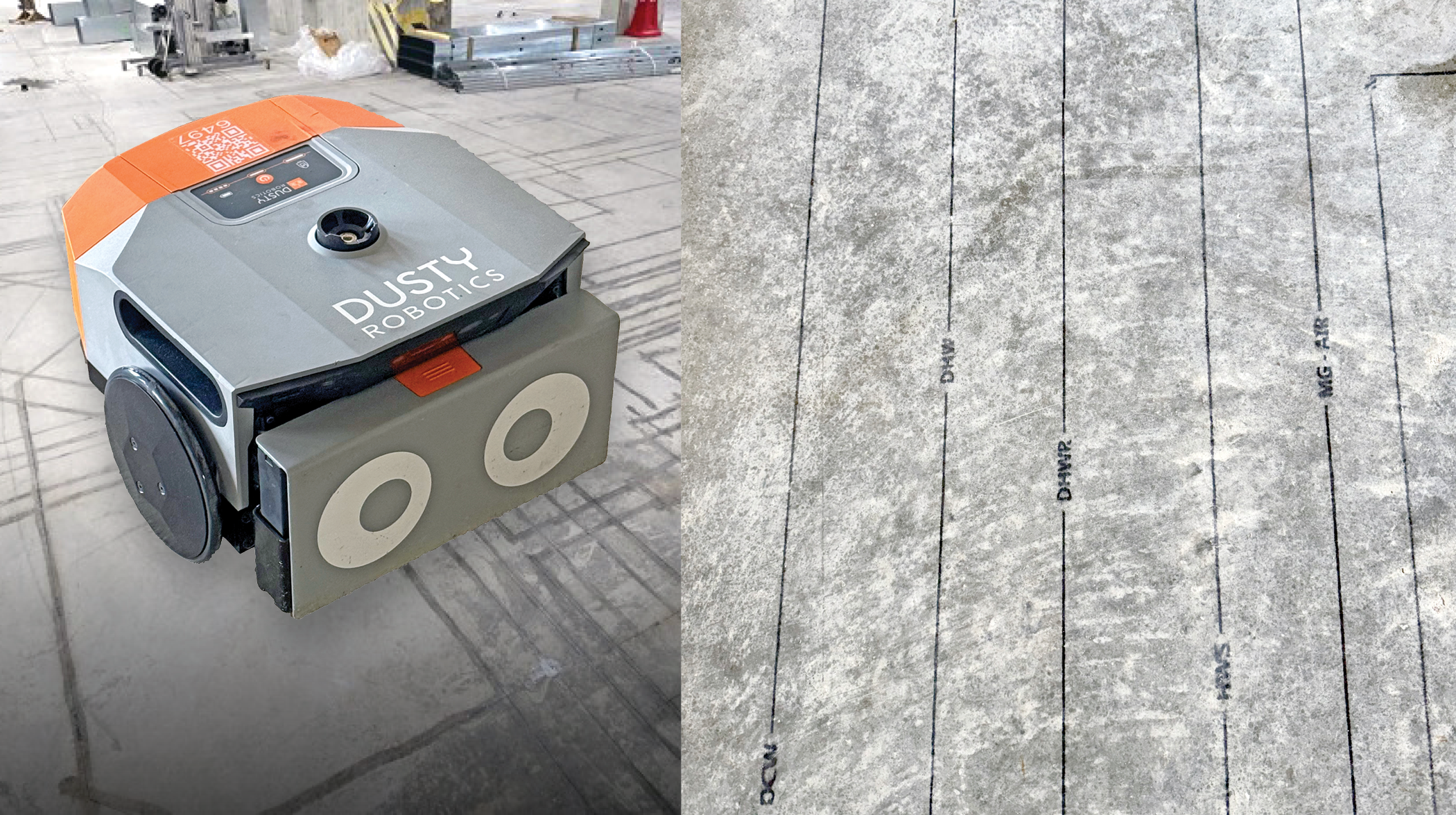
Meet Dusty, the friendly-faced layout expert who stands just inches tall. This robot prints digital model data directly onto the jobsite floor, quickly providing a multi-trade layout “map” while maintaining accuracy to 1/16 inch.
This winter, the team at Robins & Morton’s Huntsville Hospital Madison Street Tower project — a $150 million five-story vertical expansion that adds 120 patient rooms to the hospital — had the opportunity to give Dusty a test run, and the results were remarkable. Here’s a look at how it works, its key benefits, and the lessons the team learned along the way.
How Dusty Works
Measuring and snapping lines on a concrete slab — while maintaining precision and adherence to the digital model — is a tedious, time-consuming task, ripe with opportunities for human error. Dusty Robotics offers a different approach.
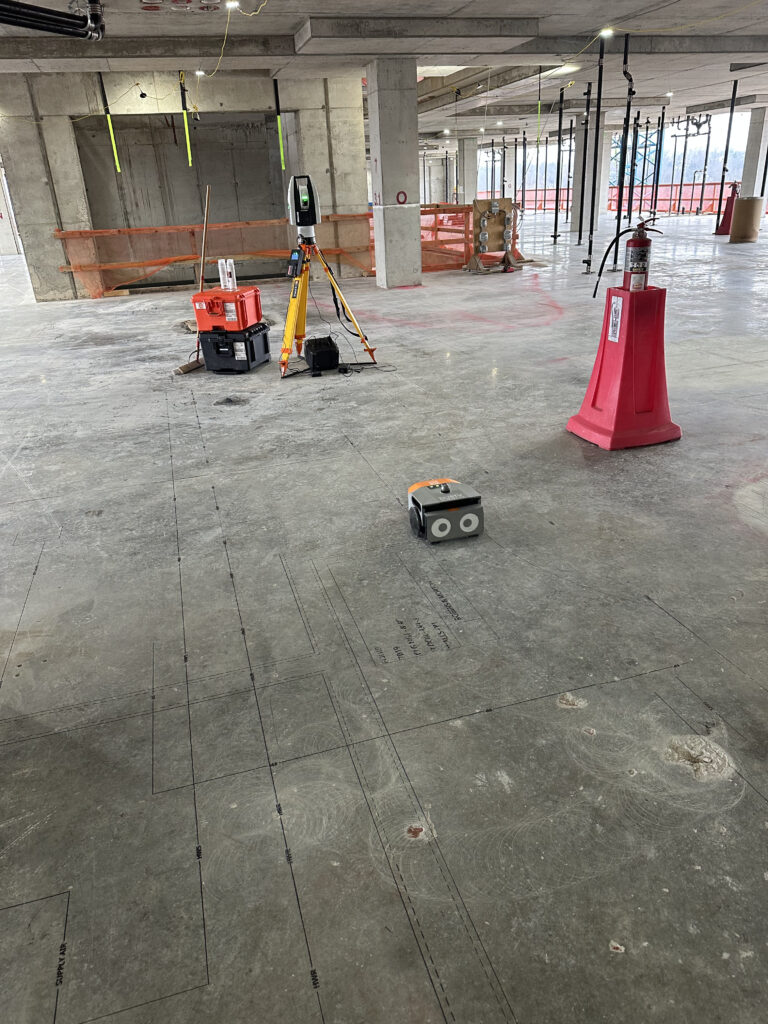
Using coordinated CAD/BIM files, Dusty autonomously navigates the jobsite and prints layout lines onto the slab or deck — so the project team builds directly from the model instead of re-interpreting it with tape, string, and chalk.
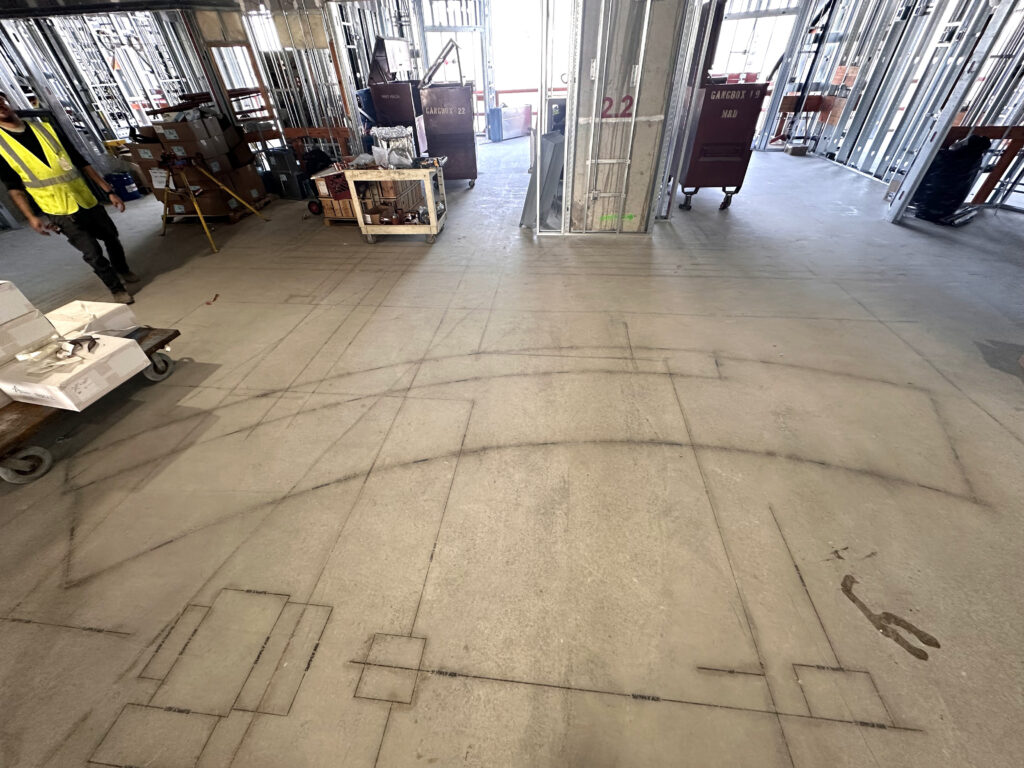
With its multi-trade layout functionality, Dusty can simultaneously print walls, sleeves, penetrations, hangers, embeds, equipment outlines, grid lines, and other install references based on what’s included in the coordinated model data. To identify which line is which, it prints text every few feet and can differentiate by color.
After it’s complete, Dusty leaves behind a layout that precisely mirrors the digital model and gives the project team a visual understanding of the work ahead.
Benefits and Lessons Learned
The Huntsville Hospital Madison Street Tower team began testing Dusty in October and finished in February. Along the way, they discovered notable benefits and learned lessons to apply to future projects.
Top Five Benefits
- Easy Learning Curve
When the Huntsville Hospital team began their test, they quickly discovered how easy it was to put Dusty to work. They trained three interns, a project engineer, a field engineer, and a carpenter foreman to operate Dusty, and they were all able to competently operate it with just one day of training.
“It was a very easy process to upload our model and start printing,” Project Manager Hunter Bullock said. “As long as you have the correct files, you can draw a line or change its type, and you can hit ‘Upload,’ you’re good.”
On the VDC side, Regional VDC Manager Raney Sledge also found the process to be user-friendly, and he noted that exporting files to Dusty was quick and efficient.
- Compressed Timelines
Manual layout is time-consuming, not only for Robins & Morton team members but also for trade contractor partners. Dusty’s automation drastically reduces layout time for everyone, compressing overall timelines. In addition, because it reduced labor costs for trade contractors, they pitched in help with Dusty’s rental cost.
“This helped everybody on the job,” Hunter said. “Our field engineers and trade contractors spend a lot of time on layout separately, and Dusty takes care of all of it at once.”
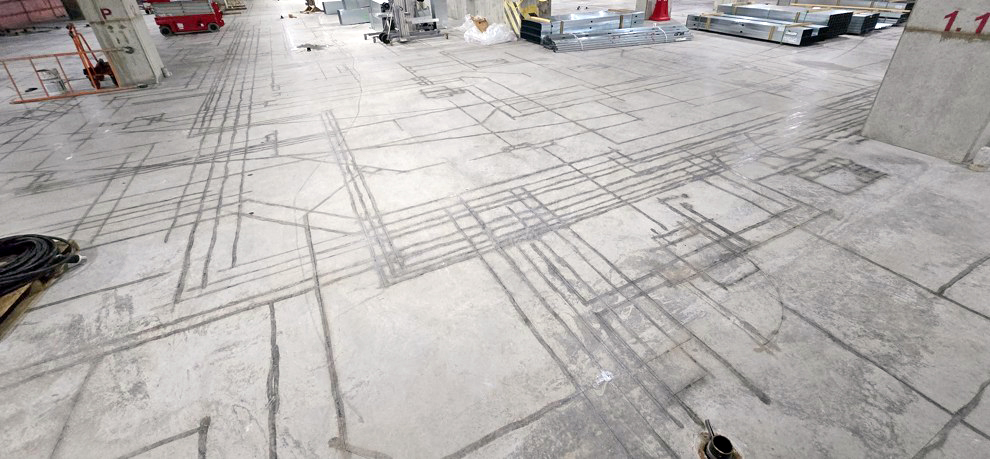
Dusty’s incredible pace and multi-trade capabilities yielded incredible time savings for the team:
“In just five days, we printed every trade contractor’s work for 20,000 square feet,” Senior Superintendent Brendan Kenny said. “That would normally take five weeks.”
- Reduced Risk
By printing straight from the model, Dusty reduces the risk that comes with manually laying out lines.
“Dusty prints the architect’s floor plan accurately, so we’re taking away the risk that someone reads the wrong number off the drawings,” Kenny said. “In that way, it also helps with quality control.”
In addition to Dusty’s native risk-reducing features, the team also implemented back checks and control lines, which acted as an extra layer of quality and further reduced risk.
- Improved Accountability
With precise, visible lines on the jobsite floor, Dusty keeps everyone accountable to the model.
“We put so much money and work into these models, and if someone doesn’t follow it exactly, there’s often finger-pointing when it comes to moving items or even figuring out new routing,” Bullock said. “This brings quality to a higher level by reducing human error and providing teams with the exact intent of the design team and coordinated models.”
As trades begin working on the jobsite, they can easily find their scopes and work efficiently.
“Once Dusty has done its job, it’s like building a LEGO® set,” Kenny said. “Each trade contractor comes in and puts the pieces where they’re marked.”
- Impressive Accuracy and Versatility
Dusty Robotics claims up to 1/16” accuracy at 600 DPI, and the Huntsville Hospital team confirmed it.
“Dusty worked as they sold it to us,” Bullock said. “It prints very accurately according to the model. It can print anything, and it can print fast.”
Dusty coordinates BIM models in one place with native Autodesk Revit and AutoCAD integrations, and the team was impressed with the range of scopes that it could print at once.
“Dusty combines all the drawings into one set,” Sledge said. “That creates incredible efficiency.”
Some of the items that can be loaded into the software to print include:
- Door swings
- Wall layouts
- Overhead
- Electrical inwall/outlets
- Bed centerline/clearances
- Clearance boxes for VAVs, ATBs, or valves
- Duct openings in walls
- Robins & Morton floor stencils
- Light layouts/rough-ins
- Can lights
- Access doors
- Soffits
- OR ceilings
- Equipment room layouts
- Tilt was panel reveals
Lessons Learned
Bringing Dusty on Board Early
One of the biggest lessons that the project team learned in its Dusty trial was that it works best when it’s involved early.
“We decided to use this a little bit later than we should have,” Kenny said. “If we would have had more up-front time, we could have leveraged it more effectively. If you have a design team bought in to using it early on, that’s even better.”
On the Dusty Robotics website, the company suggests planning for multi-trade layout “earlier than most teams do (during precon and early coordination) because multi-trade layout changes downstream scheduling.” It’s recommended that teams, “Treat the actual layout like a milestone, not a last-minute field activity.”
Using Dusty in the Right Conditions
Dusty can operate well in challenging conditions, including on damp slabs, in hot weather, and over uneven surfaces. In addition, its object clash detection system works exceptionally well.
However, the Huntsville Hospital team found it to falter a bit under extremely cold or windy conditions.
“We pushed Dusty to its max,” Bullock said. “During the ice and cold weather, we were out there in 18-degree weather, and we ended up having to bring it inside and let it warm up. You also can’t use it when it’s really windy, but otherwise we never had problems with site conditions.”
Dusty in the Future
After the success of this test, the Huntsville Hospital team considers Dusty an indispensable tool for future projects.
“Dusty would definitely be able to help on projects with more difficult layouts,” Bullock said. “We’ve spent months laying out complex projects, and there are still mistakes. But if we make sure the model’s right, Dusty can handle it. I will never not use it on a job.”
The team also looks forward to exploring Dusty’s capabilities, such as printing lines in different colors, allowing trade contractors to identify their scopes more easily.
“I’m really impressed with Dusty’s capabilities, and it has a lot of potential in the future,” Kenny said. “There’s a lot more that it can do, and I think it’ll be a great tool for us.”